What containment actually looks like
Costs, safety, bleach, lab tests and insurance — answered the way we would answer them on the phone.
There is no honest flat price for mold work, and anyone who quotes one down the phone before seeing the room is guessing. These are the ranges most residential jobs in the US land in.
The visual assessment is genuinely free: the walk-through, the moisture readings and the written estimate. There is no charge for the visit and no obligation afterwards. Laboratory sampling, if a job actually needs it, is quoted separately and you decide.
It depends on the person more than on the species. EPA and CDC guidance is that indoor mold exposure can irritate the eyes, skin, nose and throat, and can trigger asthma attacks and allergy symptoms in people who are sensitive to it. Some people react strongly and others in the same house notice nothing at all.
What no reputable remediation company will tell you is that the mold in your wall caused a specific illness. That is a question for a doctor who knows your history. What we can tell you is the practical part: mold needs water, it keeps growing while the water is there, and the room gets more expensive the longer it is left.
Not on anything porous, and most of what mold grows on in a house is porous. EPA does not recommend routine bleach use for mold remediation, and the reason is mechanical rather than chemical: bleach is mostly water. On drywall, plaster, bare wood or insulation it takes the colour off the surface while the water it is carried in soaks further into the material. The stain goes. The growth in the paper backing and the stud cavity does not, and a fortnight later it looks exactly the same.
On a hard, non-porous surface — tile, glass, a sealed countertop — detergent and a scrub will do the job, and so will bleach if you already have it under the sink. Either way the real fix is removing the water that is feeding it.
Usually not. EPA's position is that sampling is generally unnecessary when mold growth is already visible, because the result does not change what happens next — visible growth is removed the same careful way whatever the laboratory says the species is.
Sampling earns its cost in a few specific situations: a dispute with a landlord, an insurer or a seller; a persistent smell with no visible source after a proper inspection; or a clearance test somebody has asked for in writing once the work is finished. If a company leads with a test before it has looked at the room, ask why. And be wary of anyone advertising laboratory analysis as free — what is free here is the visual assessment and the written estimate.
In practice, yes. The industry says remediation, homeowners say removal, and both describe the same job. The pedantic version: removal is the part where affected material physically leaves the building, and remediation is the whole sequence around it — containment, negative air, removal, cleaning, drying, and dealing with the water source so it does not come back. Nobody sells one without the other.
What you should be suspicious of is a company that offers to spray or fog a room and call it finished. Nothing sprayed on a surface removes what is growing behind it.
Most single-room residential jobs run one to three days of crew time, plus drying. Drying is the part that cannot be hurried: air movers and dehumidifiers stay in place until the cavity reads dry on a meter, which is commonly another two to five days depending on how wet the structure got and how humid it is outside. Crawl spaces, larger areas and anything involving the HVAC take longer.
You get a real estimate on site, once somebody has read the moisture. We do not print a turnaround time on a web page, because the honest answer depends on the wall.
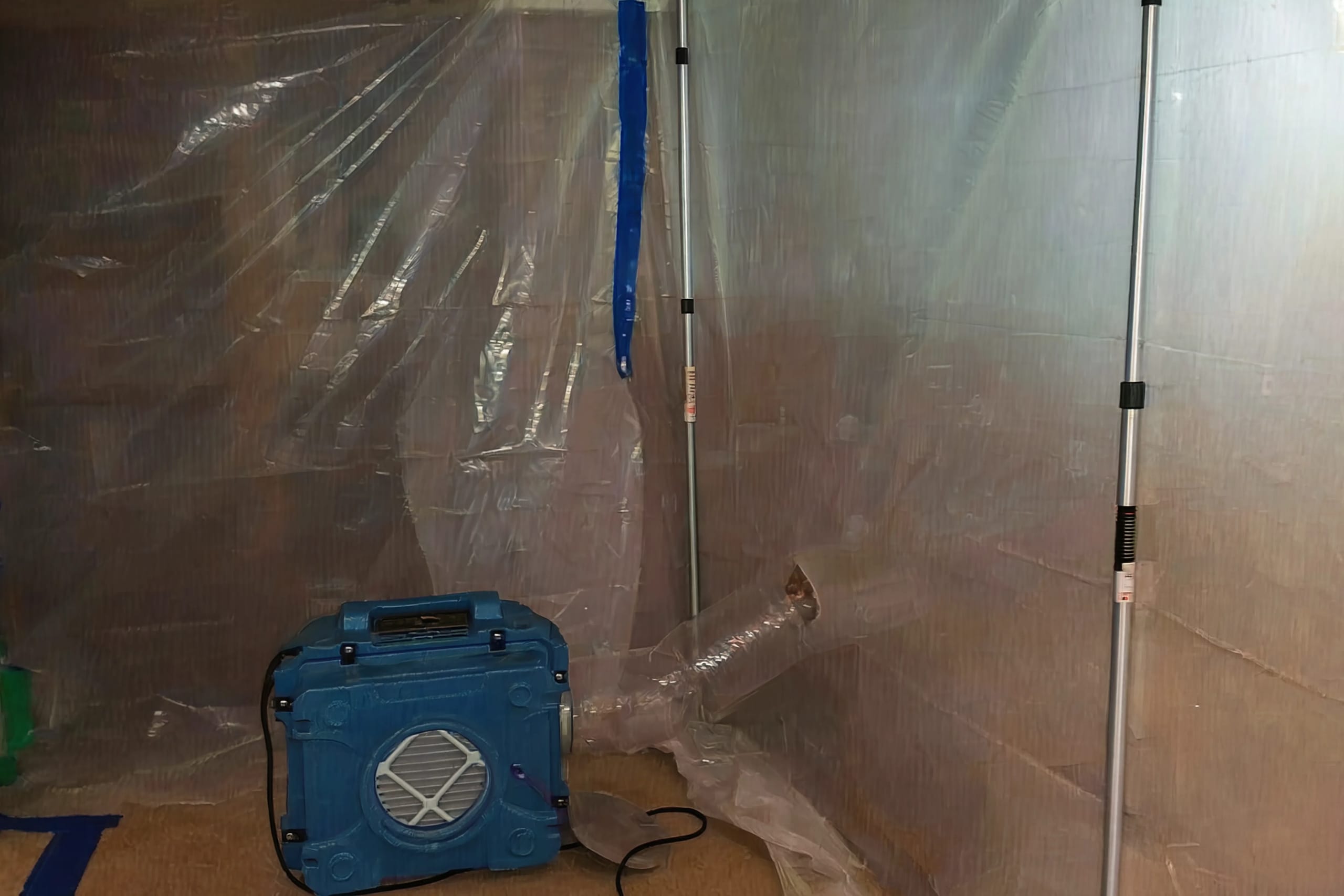
Usually not. Containment exists precisely so the rest of the house stays usable while one room is worked on: sheeting seals the work area, negative air pulls what comes off the wall out through a HEPA filter, and you carry on living in the other rooms.
You may want to be elsewhere if the work area is your only bathroom or your bedroom, if the affected area is large, or if somebody in the house has asthma or is otherwise sensitive. The crew will tell you which of those applies before they start rather than after.
It comes back if the water comes back. Mold is the symptom rather than the disease: a properly remediated wall that gets wet again will grow again within days, however well it was cleaned.
That is why the job does not end at removal. The crew traces the source, writes down what they found, and dries the structure to a meter reading instead of to the eye. If the cause is a roof, a gutter, a slab crack or a bath fan venting into the attic, you get that in writing so the right trade can deal with it. Fix the water and the room stays clean.
Sometimes, and it turns on the cause rather than on the mold. Most US homeowners policies cover mold only when it results from a sudden, accidental, covered event — a burst supply line, an appliance failure, storm damage that let water in. Damage from a slow leak, from humidity, or from maintenance that was not done is normally excluded. And even a covered claim usually carries a mold sub-limit in the low thousands, whatever the job actually costs.
Two things help. Report it quickly, and document it properly. Our crews photograph the affected areas before anything is touched, record the moisture readings, and write down what they believe the cause was — which is the evidence an adjuster asks for. We are not an insurer and cannot say what yours will pay, so read your policy's mold limit before you assume it is covered.
Yes. A technician walks the property with you, reads moisture through the walls with a meter, checks the places water actually gets to, and leaves you a written estimate for the work. There is no charge for that visit and no obligation to book anything.
What is not included is laboratory analysis. If a job genuinely needs samples sent away, that is quoted separately and it is your call.
A person answers, 24 hours a day, weekends included. They ask three things: what you are seeing, where the water came from, and how long it has been there. That is usually enough to tell whether this is a job for next week or something to move on now.
Then we take your ZIP and hand it to the certified crew that already works your area, along with what you told us, so you are not explaining it twice. The crew calls you to arrange the visit. Nobody quotes a price on that first call, because nobody has seen your wall yet.
An independent local crew, certified in mold remediation and licensed where their state requires it, working in the market they live in. Mold Free USA runs the phone line, the vetting and the standard; the crew runs the job.
We check certification, insurance and trading history before anyone is given your address. The whole arrangement is set out on the about page, and the areas we dispatch to are on service areas.
A certified crew in your area will read the moisture, tell you what is behind the wall and put the number in writing. The visit and the assessment cost nothing.